
If you've built Android apps for a while, this sentence should land differently than it would for someone new to the platform: Android Views are now officially in maintenance mode.
At Google I/O 2026, Android went Compose-first — all new UI work happens in Jetpack Compose now. XML layouts aren't disappearing tomorrow, but they're no longer where Google is investing. What I find more interesting than the announcement itself is how Google actually got here, because it wasn't one big decision.
A decade, not a rewrite
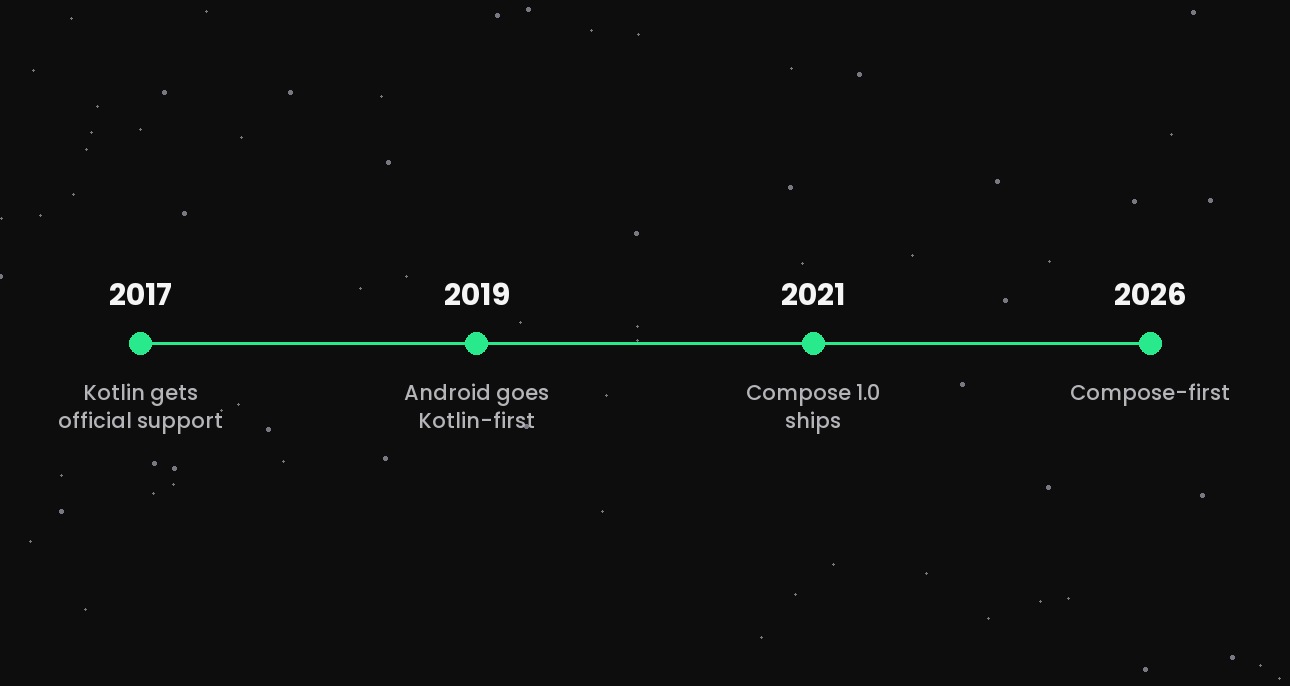
- 2017 — Kotlin gets official support.
- 2019 — Android goes Kotlin-first.
- 2021 — Compose 1.0 ships.
- 2026 — Compose-first.
Nobody was told to rewrite their app at any point in that timeline. Kotlin could sit next to Java in the same codebase, so teams wrote new features in Kotlin and left working Java code alone. Compose was built the same way — you can drop a single Compose screen into an old XML-based app and nothing else breaks. That's the part most companies get wrong when they modernize: they plan a rewrite. Google planned a gradual migration.
It wasn't smooth, either
Mixing Java and Kotlin brought back null-safety gaps at the boundary. Build times got worse with kapt, which is a big part of why KSP exists now. Early Compose had jank, scrolling that didn't feel quite right, and recomposition bugs that made you question your career choices some afternoons. Half the APIs were marked experimental for years. Google kept fixing things one release at a time instead of promising it was solved.
The numbers now
68% of the top 1,000 Play Store apps use Compose in production. TikTok cut code size by 58% on new features. Mercari removed 355K lines of code. Lyft reduced UI component code by up to 60%. Google Drive cut code and development time roughly in half. Those aren't side projects — those are some of the biggest codebases on Android.
I still remember writing RecyclerView adapters, ViewHolders and 200-line XML files for a single list screen. Today that's about 20 lines of Compose. Big migrations rarely fail because of the technology. They fail because teams try to change everything at once instead of letting the old and new sit side by side.