
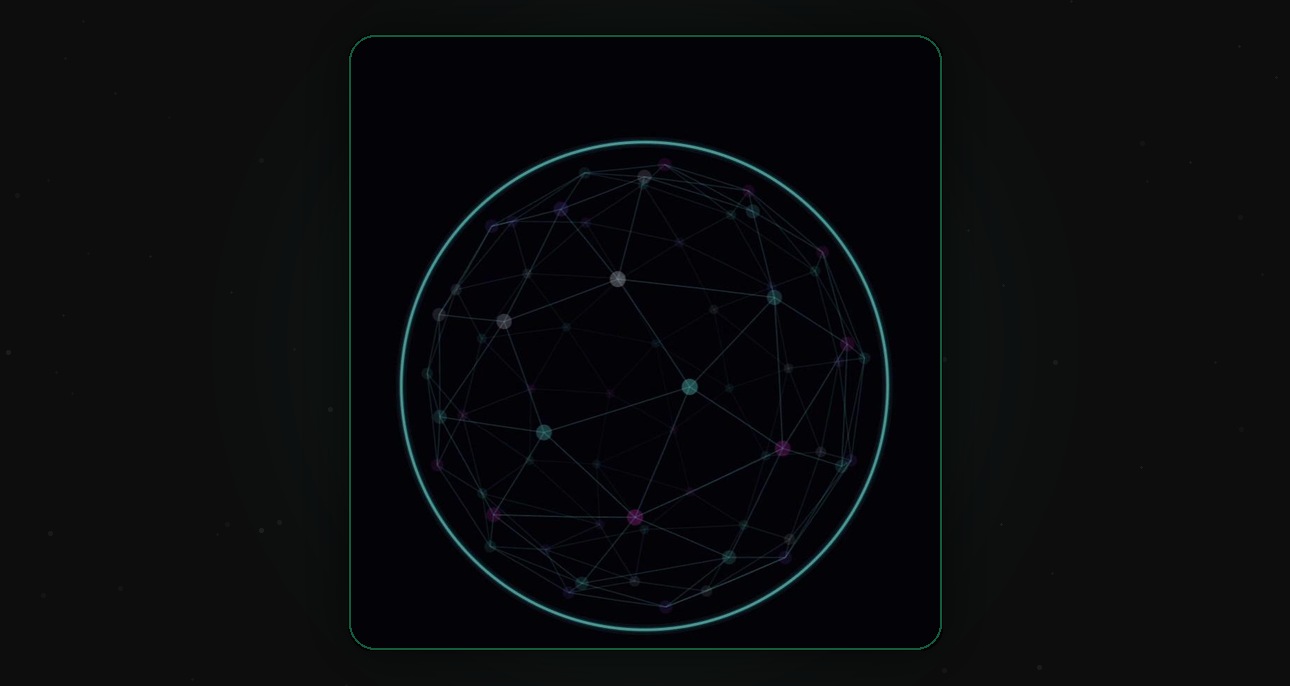
NeuralSphere is a reactive 3D-style sphere, built entirely with Jetpack Compose Canvas, sensors and text-to-speech — no 3D engine involved. Inspired by work from Kyriakos Georgiopoulos.
How it's built
Sixty-four nodes sit on a Fibonacci distribution across the sphere, each one tied to a frequency band from the speech engine. Tap it and it actually listens, pauses for a moment, then speaks back — the whole mesh flinches on hard consonants because an envelope classifier tags plosives and kicks the camera pitch on each hit.
Drag to rotate, tilt for parallax. If the device has no accelerometer, it falls back to a Lissajous curve so the sphere never looks frozen in previews or on devices without motion sensors.
The edges connecting nodes are quadratic Béziers, bowed by connection activity — that reads more like synapses firing than a static wireframe. Depth sorting runs on preallocated arrays, so there's zero garbage collection pressure at 60fps even with the whole mesh recalculating every frame.
Just sensors, TTS, and Kotlin math
No 3D library, no shader pipeline — the "3D" feel comes entirely from projecting the Fibonacci sphere points, sorting by depth, and animating node radius and edge curvature off the same audio envelope driving the TTS output. The full source, including the sensor listener and envelope classifier, is on the gist linked above.